My First Debate Competition

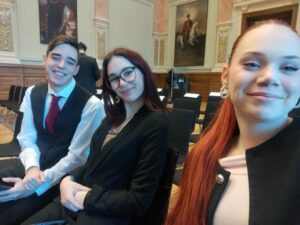
Since November, my team and I had been preparing for Politikon, a public affairs skills development and political simulation competition. Since 2021, this event has been organized annually in both Hungarian and English by the National University of Public Service and its Ostrakon College. Encouraged by our history teacher, two of my classmates and I decided to register for the competition in English.

Several rounds preceded the national finals. First, in the autumn, we had to complete an online test assessing our knowledge of history, public affairs, and general culture. After that, we had to write an essay in English on how global power relations would look if the development of nuclear weapons had been impossible. We had less than a week to complete it and submit it online. We successfully passed this stage and advanced to the next round, where we had just a few days to create a short film. The assigned topic was the U.S. presidential election, and we had to develop and present the campaign of a fictional candidate who did not belong to either the Democratic or Republican parties, following specific criteria.

At the end of the winter break, we received an email from the organizers congratulating the teams that had made it to the finals. None of us expected to get this far, and we were a bit overwhelmed by the realization that we would soon be debating for a podium position in the grand hall of the university.

We had a week and a half to prepare for the two debate topics. Our first statement in the English section was: “The global challenges of the 21st century require the EU member states to implement a strong common foreign and security policy.” The second was: “Although the UN has achieved significant milestones, it struggles to effectively address the complexities of modern global crises.”

The debate format chosen was the British Parliamentary Debate, where four delegations face each other: the Government and the Opposition, with two (in this case, three) teams on each side. The debate follows strict rules, and we prepared meticulously since this was our first official debate competition. Unfortunately, we faced teams with much more experience, and at times—even with the jury’s silent approval—we felt that their arguments were presented in a condescending manner.

Each speaker, following a predetermined order, had to speak, argue, and respond for five minutes. The side we had to represent was determined on the spot in the Széchenyi Grand Hall of the National University of Public Service, where the English-language debates took place in both the morning and afternoon sessions. As a result, we had to prepare four different scripts, but one of the most crucial elements of debate culture—spontaneous rebuttal—was something we could not fully prepare for in advance.

In our first debate, we represented the first Opposition team, meaning that, in addition to presenting our own arguments, we primarily had to refute those of the Government. We found this task more challenging, and we felt that we worked more comfortably as the Government team in the afternoon session.

Each debate lasted about an hour, including speeches, questions from the factions, and questions from the audience and judges. To me, that hour felt like an entire day. As the closing speaker, my task was to summarize the arguments presented, address the redirected questions, and respond to impromptu queries during my speech. Maintaining focus, taking notes, and formulating questions was difficult, but our biggest challenge was responding quickly and effectively under pressure.

Both the finals and the preparation day before it were mentally and intellectually exhausting. The organizers welcomed us with lectures, workshops, and non-competitive debates, helping us prepare for the challenge ahead. Those who listened to us and even the university students confirmed that, for a first-time debate team, we performed exceptionally well. We can proudly say that we secured fourth place in the national competition.

I am still unsure whether debating—especially in such formal and high-stress conditions—is my true calling, but I am glad we took on this challenge. My team and I are open to future competitions, and we have even considered signing up again next year.

Sarolta Kovács-Nagy , Kaposvár 2.
Ha tetszett a cikk, kérlek oszd meg mással is:

További bejegyzések

“Swindle” in Szentes

The 1st group of Szentes saw an unusual play on Friday evening.…

Parent-Mentor meeting

The Jászság 4 group held a parent-teacher meeting on February 19, 2026.…

Parent-Mentor Meeting in Mohács

Group 3 held its mid-term parent-teacher meeting, which focused on the evaluation…

Personality and IT skill development weekend in Pécs

The weekend developmental sessions (February 13–14) offered a meaningful and experience-rich program…

MTA 200

"According to the founding intentions of István Széchenyi, the Hungarian Academy of…

Narrative assessment and drama session

"During the weekend, the assessment of children's narrative skills continued among the…

Spectacular spring season opener in the PICK Aréna

In 2026, the beneficiaries of the Csányi Foundation once again had the…

Developmental lessons for Pécs Group 2

Even on the last weekend of the carnival season, life at the…

Busó project in Mohács

"All three groups participated in the cheerful Busó project, which took place…

Echo

In the Déryné 6 Gallery, visual artist Dániel Nyers introduced himself on…

My First Debate Competition

Since November, my team and I had been preparing for Politikon, a public affairs skills development and political simulation competition. Since 2021, this event has been organized annually in both Hungarian and English by the National University of Public Service and its Ostrakon College. Encouraged by our history teacher, two of my classmates and I decided to register for the competition in English.

Several rounds preceded the national finals. First, in the autumn, we had to complete an online test assessing our knowledge of history, public affairs, and general culture. After that, we had to write an essay in English on how global power relations would look if the development of nuclear weapons had been impossible. We had less than a week to complete it and submit it online. We successfully passed this stage and advanced to the next round, where we had just a few days to create a short film. The assigned topic was the U.S. presidential election, and we had to develop and present the campaign of a fictional candidate who did not belong to either the Democratic or Republican parties, following specific criteria.

At the end of the winter break, we received an email from the organizers congratulating the teams that had made it to the finals. None of us expected to get this far, and we were a bit overwhelmed by the realization that we would soon be debating for a podium position in the grand hall of the university.

We had a week and a half to prepare for the two debate topics. Our first statement in the English section was: “The global challenges of the 21st century require the EU member states to implement a strong common foreign and security policy.” The second was: “Although the UN has achieved significant milestones, it struggles to effectively address the complexities of modern global crises.”

The debate format chosen was the British Parliamentary Debate, where four delegations face each other: the Government and the Opposition, with two (in this case, three) teams on each side. The debate follows strict rules, and we prepared meticulously since this was our first official debate competition. Unfortunately, we faced teams with much more experience, and at times—even with the jury’s silent approval—we felt that their arguments were presented in a condescending manner.

Each speaker, following a predetermined order, had to speak, argue, and respond for five minutes. The side we had to represent was determined on the spot in the Széchenyi Grand Hall of the National University of Public Service, where the English-language debates took place in both the morning and afternoon sessions. As a result, we had to prepare four different scripts, but one of the most crucial elements of debate culture—spontaneous rebuttal—was something we could not fully prepare for in advance.

In our first debate, we represented the first Opposition team, meaning that, in addition to presenting our own arguments, we primarily had to refute those of the Government. We found this task more challenging, and we felt that we worked more comfortably as the Government team in the afternoon session.

Each debate lasted about an hour, including speeches, questions from the factions, and questions from the audience and judges. To me, that hour felt like an entire day. As the closing speaker, my task was to summarize the arguments presented, address the redirected questions, and respond to impromptu queries during my speech. Maintaining focus, taking notes, and formulating questions was difficult, but our biggest challenge was responding quickly and effectively under pressure.

Both the finals and the preparation day before it were mentally and intellectually exhausting. The organizers welcomed us with lectures, workshops, and non-competitive debates, helping us prepare for the challenge ahead. Those who listened to us and even the university students confirmed that, for a first-time debate team, we performed exceptionally well. We can proudly say that we secured fourth place in the national competition.

I am still unsure whether debating—especially in such formal and high-stress conditions—is my true calling, but I am glad we took on this challenge. My team and I are open to future competitions, and we have even considered signing up again next year.

Sarolta Kovács-Nagy , Kaposvár 2.

Ha tetszett a cikk, kérlek oszd meg mással is:

További bejegyzések

“Swindle” in Szentes

The 1st group of Szentes saw an unusual play on Friday evening.…

Parent-Mentor meeting

The Jászság 4 group held a parent-teacher meeting on February 19, 2026.…

Parent-Mentor Meeting in Mohács

Group 3 held its mid-term parent-teacher meeting, which focused on the evaluation…

Personality and IT skill development weekend in Pécs

The weekend developmental sessions (February 13–14) offered a meaningful and experience-rich program…

MTA 200

"According to the founding intentions of István Széchenyi, the Hungarian Academy of…

Narrative assessment and drama session

"During the weekend, the assessment of children's narrative skills continued among the…

Spectacular spring season opener in the PICK Aréna

In 2026, the beneficiaries of the Csányi Foundation once again had the…

Developmental lessons for Pécs Group 2

Even on the last weekend of the carnival season, life at the…

Busó project in Mohács

"All three groups participated in the cheerful Busó project, which took place…

Echo

In the Déryné 6 Gallery, visual artist Dániel Nyers introduced himself on…