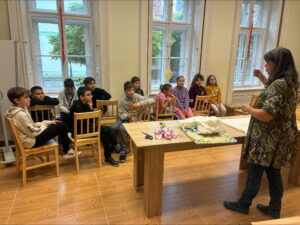
The creation of the seat cushions for our community house was carried out within the framework of a project activity, under the guidance of our art pedagogue. Making them was a complex task, which the instructor implemented step by step. First, the children became familiar with the technique used to paint the cushion fabric. Then, during a practical session, they measured and cut the material to size, tied it, dissolved the dye, unwrapped it, dried it, and afterwards, with parental assistance, sewed the pieces together.
The children listened to the art pedagogue’s presentation with great interest, and then enthusiastically created the colourful covers. The young participants spent the creative days cheerfully, enthusiastically, and — seeing the final result — with satisfaction.
— Márta Törőcsik, mentor, Szentes 2.
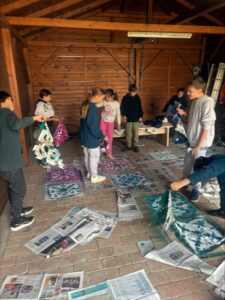
At the Szentes Community House, the patterns of the seat cushions were made using a combination of two textile-dyeing techniques.
The first method involved getting to know stencil techniques. Building on the prehistoric knowledge learned in Grade 5, we explored the world of cave paintings and, in relation to Australian rock art with handprints, figured out how they were likely made: by blowing natural paint through a tube around the hand — essentially the method known today as stencilling.
Based on this, everyone created a continuous stencil template by precisely folding and cutting newspaper in geometric patterns. The stencil was placed onto the cut pieces of canvas, and we sprayed paint through the cut-out shapes. After drying, we exchanged stencils with one another and placed them freely onto the already patterned surfaces, applying a new colour. This resulted in overlapping, varied, symmetrical patterns.
As a second textile-dyeing method, we enriched the previously created patterns with further colour and motif variations using tie-dye (batik) techniques: we placed the tied fabric into a liquid dye bath, then untied it afterwards.
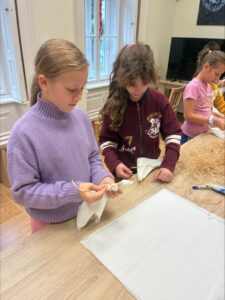
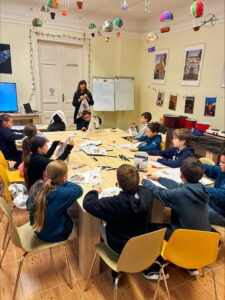
During the workflow, we developed numerous competencies: precision, professionalism, perseverance, and practice. In connection with the tricky folding, we reflected — through Rodolfó’s art of magic — on perseverance, infallibility, continuous renewal, practice, and the path leading to international fame. It was a creative, cheerful activity that offered a wealth of new knowledge.
— Mária Beke, art pedagogue