PÉCS:
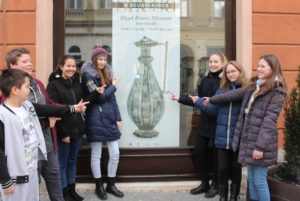
All three groups of Pécs visited Kaposvár to see the much fabled Seuso treasure.
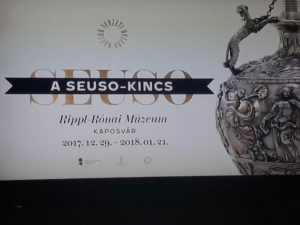
“It was very nice, I really liked the Achilles plate. I’m happy to have seen it.” Varga Péter, Pécs 2
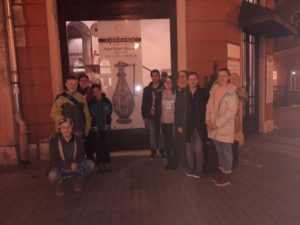
“We’re very happy to have seen them. They are priceless.” Majoros Ivett P3 “
Though I have seen them before, they still amaze me. Albert Laura P1″
Kaposvár
“Today (16 January) we visited the Seuso exhibition with Group 1 of Kaposvár in the Rippl-Rónai Museum. It was a huge experience for me though I have seen the treasures before. Thanks to our nice guide I learned many new things. The silver objects were beautiful and the patterns really impressed me. On the treasures we can find Acchilles, Pan, Poseidon and Pallas Athene. On one of the plates I could read the inscription „Pelso” which means „Balaton” in Hungarian. The treasures were found by József Sümegh who was discovered dead in unexplained circumstances.” Zsófia Trixler Group 1
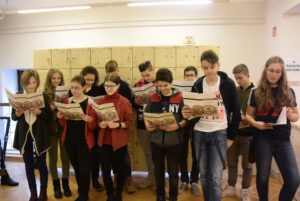
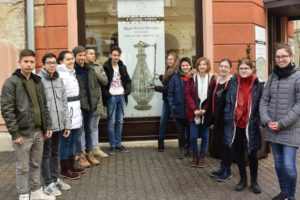
On the first weekend of the new year we went to our local museum to see something that educates, excites and makes us appreciate Roman treasures. The Seuso Treasure is currently in Kaposvár as a temporary exhibition and after having seen it, we talked about what we saw and also wrote a few recommendations in our Saturday class. Here are some for our dear friends:
‘I recommend this exhibition because this is the biggest finding of silver artefacts of this age in Hungary. Their story goes back to the Roman period as they were made then, and by all possibility they belonged to a Roman nobleman named Seuso.’ (Péter Gyurka)
‘Imagine… how the items of the Seuso Treasure were found is really worthy of a crime story, literally so, because a young soldier found the valuables but he then died under mysterious circumstances. The items vanished and reappeared in Vienna, London and later New York. Hungary has recently got them back. The biggest silver plate has a diameter of 72 centimetres and weighs almost 12 kilos. And it’s beautiful! It’s definitely something worth seeing!’ (Lilla Fekete)
‘I recommend all my friends this exhibition, which isn’t particularly big but very beautiful and interesting. The silver tableware is almost two thousand years old, so it’s invaluable. During the late imperial period it was worth around 2040 solidi. One solidus could buy a Roman soldier his armour, 88 kilos of beef, 350 litres of wheat or 109 litres of wine. So presumably Seuso was a really rich nobleman who liked hunting, as all of the plates and bowls feature mythological figures, animals and the godess of hunting.’ (Emma Sárközi)
We recommend everyone this great exhibition, which is in Kaposvár until the 21st of January.
Students of Kaposvár 2. group